
Sunken Wisdom
Vedic Myths, Lost Continents, and the Flooded Dawn of Civilization

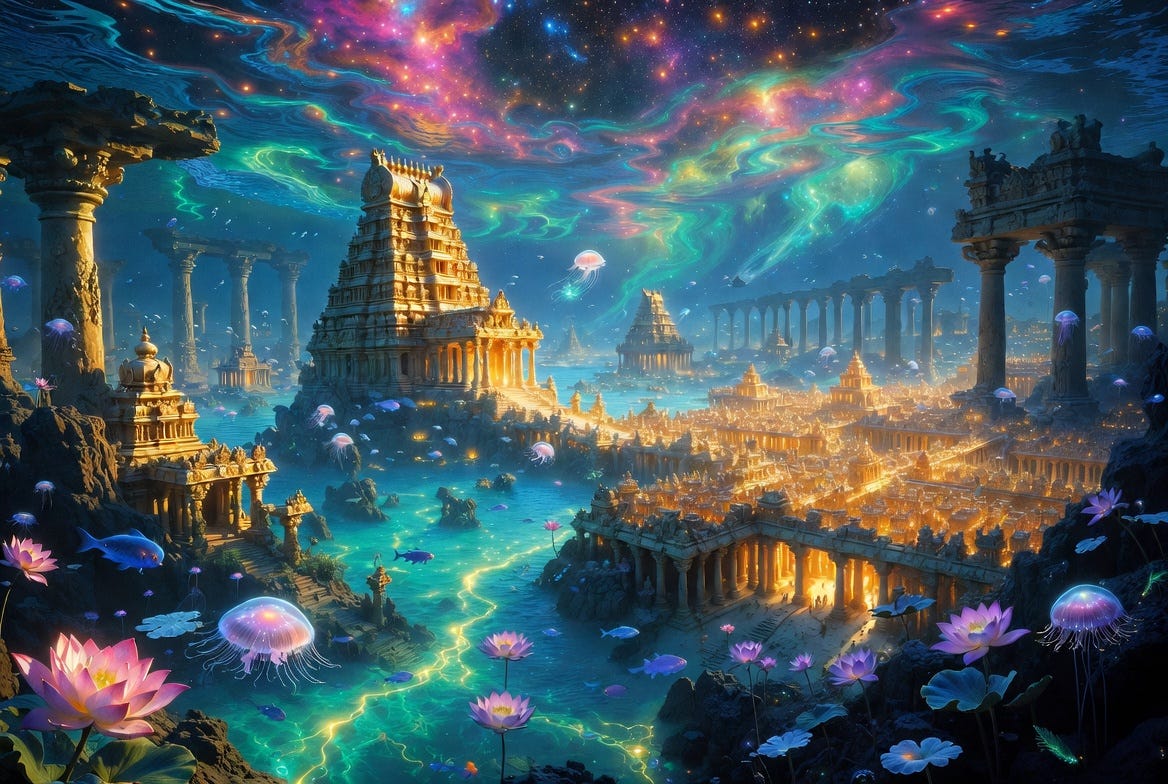
I’ve long felt that Western thought has been given more credit than it deserves, while Eastern traditions are often underappreciated. Growing up in the USA, that bias makes sense — it’s the cultural air I breathed.
But lately, something deeper has been stirring in the back of my mind. It’s led me down a path of questioning the true origins of civilization and how much of what we consider “Western” or “universal” actually has far older, Eastern roots.
This exploration of Vedic wisdom, ancient flood myths, Kumari Kandam, Sundaland, and even echoes in Atlantis feels remarkably resonant. It’s still a rough theory — I know there’s a lot more to refine and explore — but it’s the first big intuition that’s bubbled up clearly. I have several other “crazy” ones waiting in the wings (and yes, 👽are a big part of all of this) .
Anyway, I’d love to hear your thoughts. I hope you enjoy the essay!
We’re often told that the story of civilization begins in Mesopotamia, Egypt, or Greece. But if we look further back and further east, a far older and more continuous thread emerges — one rooted in the ancient traditions of India.
Hindu civilization, or more precisely the Sanatana Dharma that underlies it, may represent one of the world’s oldest living cultural systems. Its foundations stretch deep into prehistory, blending myth, philosophy, and possible memories of real cataclysmic events.
The earliest layers of Hindu tradition appear in the Vedas, composed roughly between 1500 and 500 BCE, though many scholars believe the oral roots go back even further. These texts describe a sophisticated society centered in the Sapta Sindhu (the land of seven rivers) in northern India. The Vedas are not just religious hymns — they contain cosmology, ethics, poetry, and a profound inquiry into the nature of reality.
What makes this tradition remarkable is its continuity. Unlike many ancient civilizations that rose and fell, Vedic culture evolved into classical Hinduism, influencing Buddhism, Jainism, and much of Southeast Asia. Concepts such as dharma (cosmic and moral order), karma, moksha (liberation), and the eternal self (Atman) have shaped the worldview of billions over thousands of years.
Early Vedic religion also shares deep linguistic and cultural roots with other Indo-European peoples. This suggests that core ideas about cosmic order, ritual, and the sacred may trace back to a common ancestral culture that branched outward across Eurasia.
Hindu mythology offers its own powerful account of how civilization is renewed. In the well-known story, Vaivasvata Manu is warned by Vishnu (appearing as a fish) of an impending cosmic flood. He builds a great boat, takes aboard the Seven Sages (Saptarishis), the Vedas, and the seeds of all life. After the waters recede, Manu becomes the progenitor of the new human race and re-establishes dharma.
This isn’t presented as a one-time historical event but as part of Hinduism’s cyclical view of time — periods of creation, flourishing, decline, and dissolution (pralaya). The flood myth emphasizes renewal, preservation of knowledge, and the continuity of wisdom through catastrophe.
In South India, particularly within Tamil tradition, flood legends take on a more regional and poignant character. Ancient and medieval Tamil literature speaks of Kumari Kandam — a vast, prosperous land said to have existed south of present-day India.
According to these accounts, this fabled territory was home to early Tamil Sangams (great academies of learning), advanced cities, and fertile rivers. Over time, successive floods swallowed large portions of it, forcing survivors to migrate northward and preserve their culture in the Indian subcontinent.
While the dramatic “sunken continent” version of Kumari Kandam was amplified in the 19th and 20th centuries, the core idea of lands lost to the sea has genuine roots in Tamil poetic traditions. It reflects a cultural memory of environmental upheaval and the resilience of a people.
Here’s where mythology meets geology in a compelling way.
At the end of the last Ice Age, between roughly 12,000 and 8,000 years ago, global sea levels rose dramatically as massive ice sheets melted. Entire continental shelves vanished beneath the waves. Two particularly significant landmasses were affected:
Sundaland — a vast, now-submerged region connecting mainland Southeast Asia with Sumatra, Borneo, Java, and other islands.
Sahul — the ancient continent that united Australia, New Guinea, and Tasmania.
These weren’t small islands but enormous habitable territories that supported human populations for tens of thousands of years. Their gradual (and sometimes rapid) inundation would have been traumatic for the people living there, likely generating stories of lost homelands passed down through generations.
Interestingly, this same period of catastrophic flooding may explain similar legends elsewhere in the world. Plato’s famous account of Atlantis — an advanced island civilization that sank into the sea in a single day and night — could be another cultural memory of these real environmental upheavals. While often treated as pure myth or moral allegory, many researchers see Atlantis as a distant echo of the massive sea-level changes that reshaped coastlines worldwide at the dawn of the Holocene.
Some have even speculated that memories of Sundaland’s flooding, carried by coastal migrations, could have contributed to legends like Kumari Kandam — and possibly influenced stories that later reached the Mediterranean. While direct connections remain speculative, the global pattern is striking: multiple ancient cultures preserving tales of prosperous lands swallowed by the ocean during the exact same geological window.
What emerges is a picture of Hindu civilization as one with exceptional antiquity and resilience. Far from being a late arrival, it appears to preserve some of humanity’s oldest continuous spiritual, philosophical, and cultural streams — possibly carrying faint echoes of the environmental upheavals that reshaped our planet at the end of the Ice Age.
This doesn’t diminish the achievements of other civilizations. Rather, it invites us to see human culture as a vast, interconnected web. The values of duty, cosmic harmony, ethical causation, and spiritual inquiry that Hinduism has nurtured for millennia have quietly influenced much of Asia and, through indirect channels, the wider world.
In an age obsessed with the new and the novel, it’s worth remembering that some of the deepest roots of human thought may lie in the ancient temples, rivers, and unbelievably ancient wisdom of the Indian subcontinent.
Meditation:
“Who really knows?
Who will here proclaim it?
Whence was it produced?
Whence is this creation?
The gods came afterwards, with the creation of this universe.
Who then knows whence it has arisen?
Whether He created it or did not create it,
Only He who is its overseer in the highest heaven knows,
Or perhaps He does not know.”
—Rig Veda 10.129 (Nasadiya Sukta—Hymn of Creation)
In the Mayan tradition they have a flood story in the second creation. I feel the reason we have myth that survived is because the Earth takes her land back after so long. These are the rabbit holes I love 🙌🏻 good stuff
Really enjoying reading this. I have always wondered about Kumari Kandam and if it could be Atlantis. Most say - no. Will we ever solve any of these mysteries? I think our ancestors were brilliant, and we sometimes have to start over again because we get ahead of ourselves.